
A Note from Dr. Clarizio
Since my college days, (I majored in biomedical engineering), I have been fascinated with the concept of replacing teeth. I spent a great many hours in the engineering research lab trying to figure out how to make the implants available in the early 80’s better. In the late 80’s and early 90’s my primary interest was determining how to make the use of implants more predictable.
My current interest in implant dentistry has evolved into fine-tuning the implant placement process. My goals are to maximize the esthetics of the final restoration and minimize any inconvenience to my patients by making the process more efficient. When I’m not practicing implant dentistry I share my experiences with fellow dentists, both surgical and restorative, throughout the world.
The implants in all the cases presented on this site, including the multimedia program, were all placed by me in the Seacoast area since 1987.
We Will Help You
Usually, when you lose a tooth, it is best for your oral health to have it replaced. Missing teeth can affect your “bite” as well as your ability to speak and chew. Their loss can increase the burden on your remaining teeth and can cause muscle pain in your jaws and headaches. And of course, losing a tooth can affect your appearance. The good news is that, most of the time, replacing a missing tooth is not an emergency. You have time to consider what replacement option is best for you and to make an informed decision. We will help you make that decision.
What are my tooth replacement options?
- “Flipper” – a removable plastic tooth that is inexpensive but fragile and temporary.
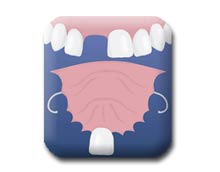
- Cast partial denture – also removable, but is precision cast in metal for longer service life. Wire clips help hold it in place.
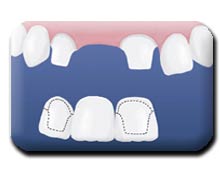
- A fixed bridge is cemented into place using crowns or “caps” on the teeth adjacent to the open space for support. Crown placement usually requires removing or reducing the outer layer of the tooth. In some cases, a “Maryland” bridge, a fixed bridge that does not need crowns, is glued onto the back of the teeth adjacent to the space so that minimal tooth structure is removed.
- Full dentures or “plates” – the traditional solution for people who have lost all their teeth in one or both jaws. The success of a full denture depends upon the individual’s jaw size and shape, his or her oral habits, and his or her adaptability. Some people adapt well to full dentures, while others are not able to adapt. Dental implants can be used to provide support for the replacement of one tooth or all of an individual’s teeth. After years of research and clinical trials, we can now provide this option in addition to the traditional treatments just described. Implant-supported teeth can be cemented, screw-retained, or removable and can be made attractive, stable, and comfortable for almost any patient.
Are dental implants an option for me?
If you are considering dental implants, your mouth will be examined thoroughly and your dental and medical history will be reviewed to ensure that dental implants are appropriate for you. Dental x-rays and, frequently, panoramic (or complete) x-rays of your jaws will be taken to evaluate your jawbone and to determine if it will accommodate implants. Occasionally, more detailed information is required and can be provided by special x-rays. They will help determine if additional tests or procedures are needed to place your implants properly.
What is a dental implant?
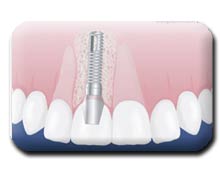
The best way to describe a dental implant is to compare it to a real tooth. A natural tooth consists of a root and a crown. The part of the tooth that you see and eat with is called the crown. Beneath the crown is the root, which anchors the tooth through the gum tissue to the jawbone. When you lose a tooth, you lose both the root and the crown. To replace a tooth, we first have to replace the root. Essentially, a dental implant is a new root. This titanium root is fitted into a socket that we create in your jaw, replacing the lost root of your natural tooth.
Dental implants come in various shapes and sizes and have different types of surfaces. The actual implant selection will depend on a variety of factors related to your specific treatment needs and the most appropriate one(s) will be used. Once an implant has been placed in the jaw, the bone around the implant will need to heal for two to six months, depending upon how hard the bone is. When this initial phase of healing is completed, a support post called an abutment will be placed into the implant itself and then a new crown will be placed on top. If all of your teeth are missing, a variety of treatment options are available to support the replacement teeth.
How are dental implants placed?
Usually, the office procedure to place a dental implant takes about an hour for one implant and no more than two or three hours for multiple implants.
The placement process consists of the following steps:
- If indicated, you will be given medication such as antibiotics prior to the surgery. You may be offered sedation with nitrous oxide (“laughing gas”) or intravenous medications. Then, a local anesthetic will be administered to numb the areas where the implant/s will be placed.
- After you are comfortable, a small incision is made into the gum tissue, revealing the bone into which the implant will be placed.
- Using special instruments, a socket is created carefully, avoiding damage to the bone.
- The titanium implant is then inserted into the socket.
- Finally, if necessary, sutures will be used.
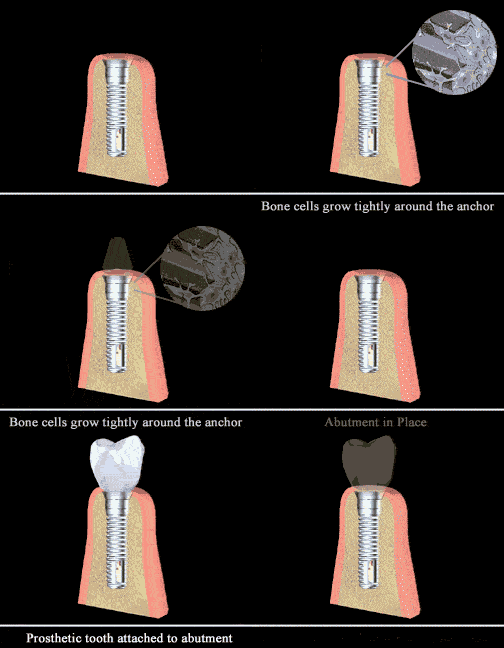
After the implant is placed, the area will need to heal for as long as six months. How long your mouth will need to heal will be determined by a variety of factors. Follow-up care (one to four appointments) is usually needed to ensure that your mouth is healing well and to determine when you are ready for the restorative phase of your treatment.
The dental work required to complete your treatment is complex. It is, however, considered more comfortable and more pleasant than conventional dental care. Frequently, most of the work can be done without using even local anesthesia.
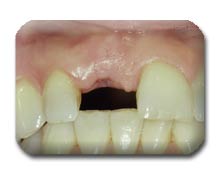
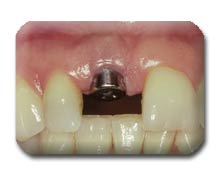
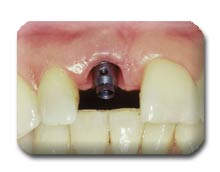
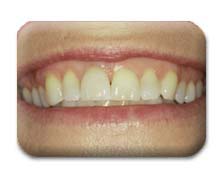
Your restorative treatment begins with specialized impressions that allow us to produce a replica of your mouth and implants. We will also make “bite” records so that we see the relationship of your upper and lower jaws. With this information, we will make the abutments (support posts) that attach your replacement teeth to your implants. Various types of abutments exist. Frequently, we can use “off the shelf” abutments. Other times, custom abutments must be made of gold or a tooth-colored ceramic material. As you can imagine, these custom-made abutments add to the cost and treatment time involved. Which abutment to use is a decision that often cannot be made until after healing is complete and impressions have been made.
The number of appointments and the amount of time required for each appointment is different for each patient. No two cases are exactly the same and regardless of the number of teeth replaced, the work must be completed with great precision and attention to detail. If you are having only a few teeth replaced, there as few as three short appointments may be required. Between appointments, we will need time to complete the necessary lab work to make your replacement teeth.
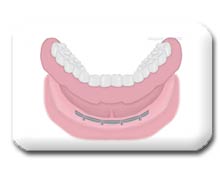
If your final restoration is a removable denture, you will need to come to as many as five office appointments (although it may be fewer) over the following several months. During these appointments, we will perform a series of impressions, bites and adjustments in order to make your new teeth as well as the custom support bars, snaps, magnets, or clips that will secure your teeth to the implants. During this period we will make every effort to make certain you have comfortable temporary replacement teeth.
In general, once your implants are placed, you can expect your treatment to be completed anywhere from two to 12 months. For these reasons, it is difficult for us to tell you exactly how much the restorative phase of your treatment will cost, although you should receive a reasonable estimate of costs . It also is difficult to give you a specific timeframe for completion of your treatment until after the implants are ready for restoration.